Welcome to DU!
The truly grassroots left-of-center political community where regular people, not algorithms, drive the discussions and set the standards.
Join the community:
Create a free account
Support DU (and get rid of ads!):
Become a Star Member
Latest Breaking News
Editorials & Other Articles
General Discussion
The DU Lounge
All Forums
Issue Forums
Culture Forums
Alliance Forums
Region Forums
Support Forums
Help & Search
General Discussion
Related: Editorials & Other Articles, Issue Forums, Alliance Forums, Region ForumsThe most elusive founder, whose pamphlet fired up a revolution

https://www.washingtonpost.com/opinions/interactive/2026/thomas-paine-common-sense-heretic/
https://archive.ph/98A6B
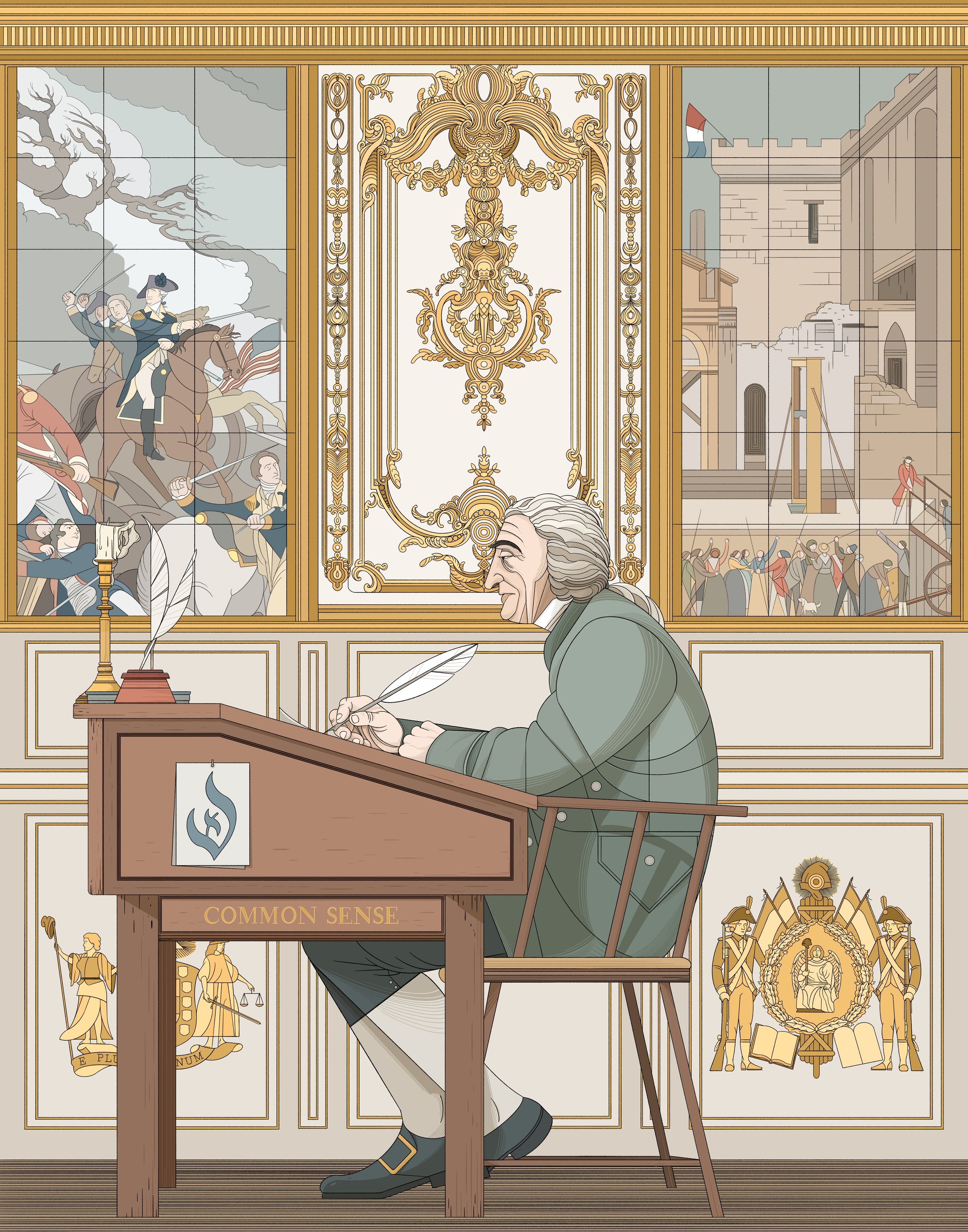
“Common Sense,” the pamphlet that helped spark the American Revolution, turns 250 this month. But despite its author’s centrality in the Revolutionary pantheon, Thomas Paine has always been the most elusive founder. Abraham Lincoln reportedly said, “I never tire of reading Paine” and praised him as one of the greatest founders because equality, to him, was a “great fundamental principle.” By contrast, others dismissed Paine as a radical extremist. John Adams said Paine “has a better hand at pulling down than building,” dismissing his polemics for producing “confusion and every evil work.” In Theodore Roosevelt’s eyes, Paine was a “filthy little atheist.”
In fact, neither the attempts to whitewash or exaggerate Paine’s radicalism do justice to his principled devotion to liberty, equality and reason. He was an abolitionist who was among the first to denounce slavery as a violation of Christian ethics and to equate Britain’s tyrannical attempts to enslave White Americans with White Americans’ enslavement of African Americans. And Paine’s 1794 treatise “The Age of Reason” was an argument not in favor of atheism but against it, grounded in Paine’s conviction that faith could be reconciled with reason.
As Edward J. Larson notes in his book “Declaring Independence: Why 1776 Matters,” in March 1775, Paine met a future signer of the Declaration of Independence, Benjamin Rush, with whom he shared common cause regarding the abolition of slavery. Years later, Rush recalled “I called upon Mr. Paine, and suggested to him the propriety of preparing our citizens for a perpetual separation of our country from Great Britain, by means of a work of such length that would obviate all the objections to it. He seized the idea with avidity.”
In other words, Rush asked Paine to write the revolutionary pamphlet after they had a meeting of minds. Rush also suggested a publisher, as well as the title “Common Sense.” And throughout the pamphlet, Paine insists that hereditary monarchy leads inevitably to slavery. “It is easy to see that when republican virtue fails, slavery ensues,” Paine wrote. “We may be as effectually enslaved by the want of laws in America, as by submitting to laws made for us in England.”
snip
3 replies
 = new reply since forum marked as read
Highlight:
NoneDon't highlight anything
5 newestHighlight 5 most recent replies
= new reply since forum marked as read
Highlight:
NoneDon't highlight anything
5 newestHighlight 5 most recent replies
= new reply since forum marked as read
Highlight:
NoneDon't highlight anything
5 newestHighlight 5 most recent replies
The most elusive founder, whose pamphlet fired up a revolution (Original Post)
Celerity
11 hrs ago
OP

bucolic_frolic
(54,163 posts)1. What did Trump say after he read Paine's "Common Sense"?


Celerity
(53,801 posts)2. Trump reads?


appmanga
(1,388 posts)3. "Well, it's great writing...
"...filled, you know, with common sense, something today's press, who are the enemy of the people don't use, and I know because I have the best common sense. I took a common sense test, and I aced it. Some of the questions were really hard, like 'Would you jump off a seven story building if someone offered you a dollar?' A lot of people don't know the answer to that, but I aced it So, yeah, he was a good writer, Tim Kaine".