The F Word -- The Atlantic via Digby
https://digbysblog.net/2026/01/25/the-f-word-3/
It's time (The Atlantic):
Until recently, I resisted using the F-word to describe President Trump. For one thing, there were too many elements of classical fascism that didn't seem to fit. For another, the term has been overused to the point of meaninglessness, especially by left-leaning types who call you a fascist if you oppose abortion or affirmative action. For yet another, the term is hazily defined, even by its adherents. From the beginning, fascism has been an incoherent doctrine, and even today scholars can't agree on its definition. Italy's original version differed from Germany's, which differed from Spain's, which differed from Japan's.
I accepted President Biden's characterization of the MAGA movement as "semi-fascist" because some parallels were glaringly apparent. Trump was definitely an authoritarian, and unquestionably a patrimonialist. Beyond that, though, the best description seemed to be a psychological one propounded by John Bolton, Trump's first-term national security adviser: "He listens to Putin, he listens to Xi, he listens to how they talk about governing unburdened by uncooperative legislatures, unconcerned with what the judiciary may do, and he thinks to himself, Why can't I do that? This doesn't amount to being a fascist, in my view, [or] having a theory of how you want to govern. It's just Why can't I have the same fun they have?"
Writing a year ago, I argued that Trump's governing regime is a version of patrimonialism, in which the state is treated as the personal property and family business of the leader. That is still true. But, as I also noted then, patrimonialism is a style of governing, not a formal ideology or system. It can be layered atop all kinds of organizational structures, including not just national governments but also urban political machines such as Tammany Hall, criminal gangs such as the Mafia, and even religious cults. Because its only firm principle is personal loyalty to the boss, it has no specific agenda. Fascism, in contrast, is ideological, aggressive, and, at least in its early stages, revolutionary. It seeks to dominate politics, to crush resistance, and to rewrite the social contract.
Over Trump's past year, what originally looked like an effort to make the government his personal plaything has drifted distinctly toward doctrinal and operational fascism. Trump's appetite for lebensraum, his claim of unlimited power, his support for the global far right, his politicization of the justice system, his deployment of performative brutality, his ostentatious violation of rights, his creation of a national paramilitary police--all of those developments bespeak something more purposeful and sinister than run-of-the-mill greed or gangsterism.
When the facts change, I change my mind. Recent events have brought Trump's governing style into sharper focus. Fascist best describes it, and reluctance to use the term has now become perverse. That is not because of any one or two things he and his administration have done but because of the totality. Fascism is not a territory with clearly marked boundaries but a constellation of characteristics. When you view the stars together, the constellation plainly appears.
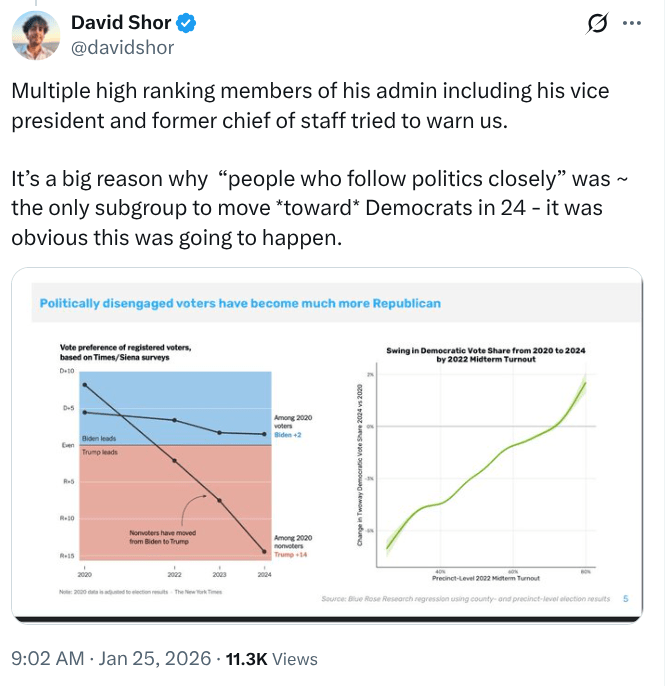
Yes it does. And many of us saw it coming:
Here it is:
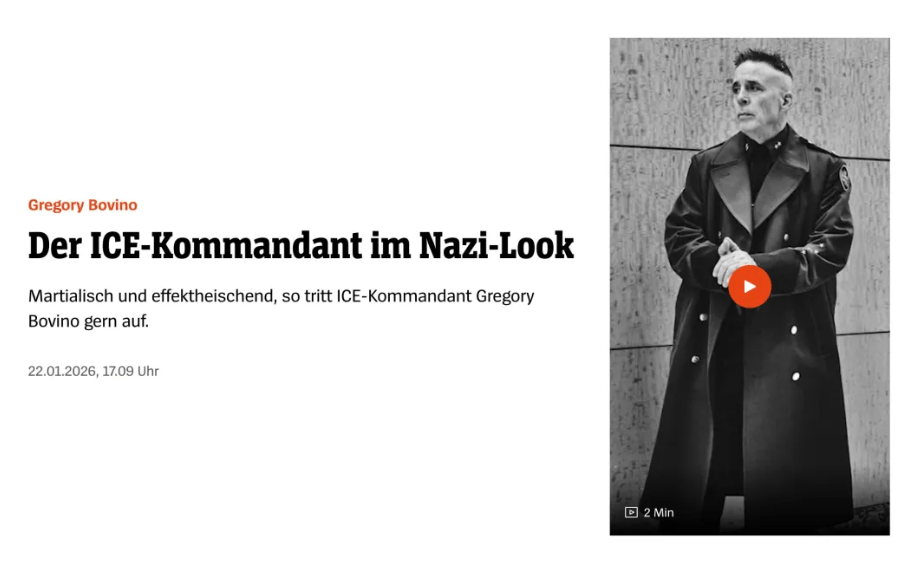
The Germans know.
