General Discussion
Related: Editorials & Other Articles, Issue Forums, Alliance Forums, Region ForumsThe Context You Need to Understand The Supreme Court's Tariffs Decision
This case involves tariffs being authorized under a statute that never mentions tariffs. This should have been an easy descision.
Link to tweet
https://joycevance.substack.com/p/the-context-you-need-to-understand?utm_campaign=post-expanded-share&utm_medium=web&triedRedirect=true
We discussed this case extensively ahead of oral argument on November 5, last year. Congress has the power to impose tariffs. But it has, in some cases, “loaned” them to the president, in specific grants with limitations. Here, the Court considered this administration’s claim that the president had the power to impose tariffs, without any limitations, under the International Emergency Economic Powers Act (IEEPA). The administration contended that the president has that power because the statute says that the president can regulate the importation of foreign goods if there is “any unusual and extraordinary threat” that poses a national emergency......
“This is not a case about tariffs in general or about whether they are good policy. It’s a case about specific tariffs that President Trump imposed in February and whether he had the statutory authority to impose them…
We studied the U.S. Court of Appeals for the Federal Circuit’s decision that rejected Trump’s effort to impose tariffs using IEEPA (I-E-Pa), the 1977 International Emergency Economic Powers Act, for the very simple reason that the Act, unlike other statutes that do give a president the right to impose tariffs, doesn’t mention tariffs at all. It does not give the president any authority to impose them under the statute that he has expressly said he used to do so. This is the kind of textualist argument conservative justices have backed in other cases, and to abandon that approach here would be a sharp and hypocritical departure for them. Last term, Justice Gorsuch wrote that the justices’ primary focus should be on the text of the statute.
The Constitution gives the power to impose taxes, which includes tariffs, to Congress. Because IEEPA doesn’t extend that power to the president, his use of it here is just a power grab, the kind of practice the Supreme Court should push back against if it intends to remain relevant to the American experiment. The Federal Circuit’s decision pointed out that while other laws expressly give the president the power to impose tariffs, IEEPA does not. Congress knows how to give the president the power to impose tariffs when it wants to and because it did not do so here, that should be the end of the inquiry. The administration should lose here…”
Thankfully, it did.
Under basic statutory construction, this should have been a 9-0 decision.
 = new reply since forum marked as read
Highlight:
NoneDon't highlight anything
5 newestHighlight 5 most recent replies
= new reply since forum marked as read
Highlight:
NoneDon't highlight anything
5 newestHighlight 5 most recent replies

Walleye
(44,256 posts)
LetMyPeopleVote
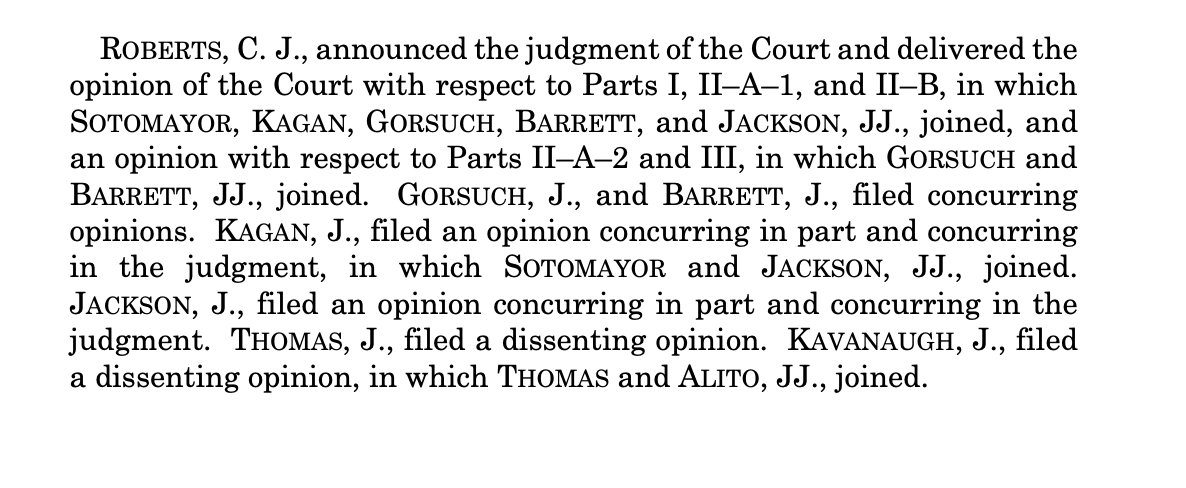
(177,573 posts)I listened to the oral arguments and did not think that this would be that close of a decision but this is a very divided opinion which is why it took so long to come down. This is a ridiculous number of opinions for this ruling
Link to tweet
Walleye
(44,256 posts)It seems so many, especially Republicans have forgotten the basic principles of the constitution. Taxes go through the peoples house. I hope they are happy letting their presidents get away with this shit all these years and look what they created
bluestarone
(21,794 posts)The other way? Then what? You see that's where we are at today, i'm afraid. THAT day will come.
Walleye
(44,256 posts)bluestarone
(21,794 posts)

leftstreet
(39,757 posts)Raised prices because TariFfs
Tax payers will reimburse the corporations
Prices won't go down