General Discussion
Related: Editorials & Other Articles, Issue Forums, Alliance Forums, Region ForumsThis was the first ship-to-ship communications ever to take place in space. #NASA (ISS to Artemis)
How cool is that?
Yesterday, the crew of the ISS called the crew of #Artemis2 and had a short conversation in between their busy schedules of research and documentation (I promise, to a scientist, that's more fun than it sounds!)
— Jessý Potato (@markdownhandsup.bsky.social) 2026-04-08T08:54:43.063Z
This was the first ship-to-ship communications ever to take place in space. #NASA
 = new reply since forum marked as read
Highlight:
NoneDon't highlight anything
5 newestHighlight 5 most recent replies
= new reply since forum marked as read
Highlight:
NoneDon't highlight anything
5 newestHighlight 5 most recent replies

Nittersing
(8,395 posts)
riversedge
(80,912 posts)amongst other ships in space.
Learn something new everyday 

displacedvermoter
(4,610 posts)a symbolic communication with one of the Russian crews over the years. Cool first, I agree.

lastlib
(28,329 posts)The Soviet Union did it in 1962 with Vostok 3 and 4, launched a day apart, and coming within a few kilometers of each other. They did communicate with each other during their approach.
Maybe it depends on what you count, but there have been numerous times that the US program has had two vehicles that might've communicated with each other. The Apollo program, with command and lunar modules separated, presented opportunities for ship-to-ship communication. Gemini 6 & 7 did the first US in-space rendezvous of manned ships, and it's hard to imagine that the two didn't exchange communication.
So no, the ISS/Artemis isn't the first.

Kid Berwyn
(24,496 posts)
They gabbed and gabbed…
lastlib
(28,329 posts)...(and couldn't verify directly) that it was actually ship-to-ship, without ground connection. I was only eight at the time, and my memory of the details of what went on are hazy to non-existent. 
Kid Berwyn
(24,496 posts)Remember Apollo-Soyuz in 1975? Deke Slayton finally got to go into space at the cost of his leaving as head of the Astronaut Office at NASA -- clearing the way for solid rocket motors being OK'd as an integral part of the Shuttle launch system and now the Artemis booster. If you haven't read it, Joseph and Susan Trento tell the story in "Prescription for Disaster: From the Glory of Apollo to the Betrayal of the Shuttle."
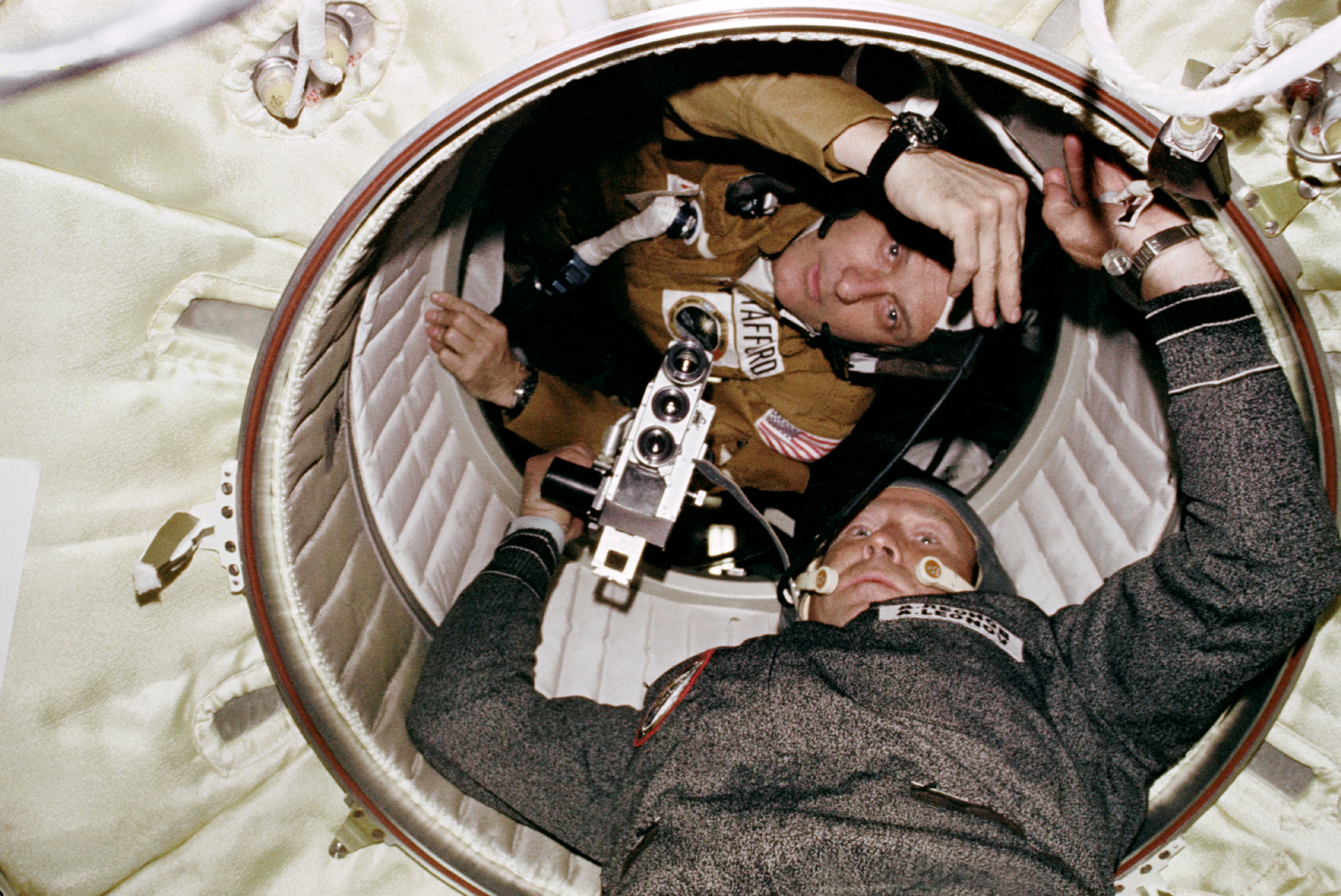
Above Thomas Stafford (Apollo 10 lunar landing dry-run) and Aleksei Leonov (first man to walk in space) shake hands in the tunnel linking their two spacecraft. Interesting times to grow up, the Space Age.
lastlib
(28,329 posts)I was just graduated from high school, and the US Navy was REALLY after me to enlist. I was watching Apollo/Soyuz getting ready to join up and do their handshake, and just as they were getting ready to open the hatch, the damn recruiter called me! We had a wall-mounted phone with a not-very-long cord to the handset, so I couldn't see the TV and talk on the phone at the same time. Recruiter said he hoped I was considering the Navy; naturally, I wanted to get RID of this guy and watched the mission, so I said sure, just send a ship around to get me, and I'll sign right up. Slammed the receiver in his ear, hung up and went back just in time to see them do the handshake. Never heard from the recruiter again, and of course the ship didn't come up my hill, so I never signed up.
Kid Berwyn
(24,496 posts)While the recruiters let this then-young hippie be: I, too, grew up during the race to the moon days.
An online resource for those who enjoy the exploration of space:
https://www.nasa.gov/a-to-z-of-nasa-missions/#G
Imagine if we had invested money into space exploration instead of destroying Vietnam and whoever else was in the way of colonial resource extraction?
lastlib
(28,329 posts)Healthcare and education would be free, a basic income would be guaranteed! And we would have the international space base on the moon!
That's a cool site, BTW! Thanks for passing it along! 

tinrobot
(12,069 posts)Wouldn't that also qualify as "ship to ship" communication?

Mysterian
(6,525 posts)I think this is a bogus claim.

EarlG
(23,658 posts)the Scientific American article explains this first more clearly:
At the time of the last manned moon missions in the early '70s, there were no orbital habitats.