General Discussion
Related: Editorials & Other Articles, Issue Forums, Alliance Forums, Region ForumsHappy Sunday. Now a reading from the gospel of Saint Caligula.
Caligula - the Mad Emperor who Declared War on the Sea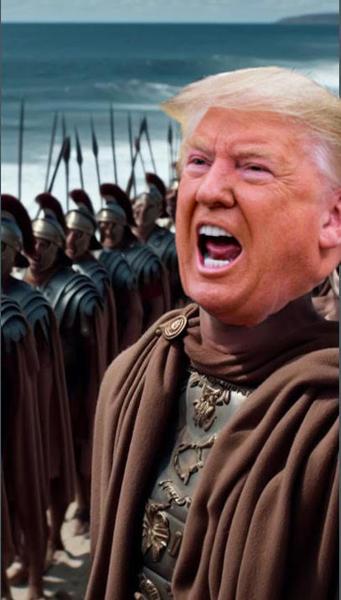
Trumpets sounded, arms were raised, and the soldiers awaited further instructions as if facing a real enemy.
Then, with no warning, Caligula dismissed the battle and declared victory. Ancient authors later interpreted this as a symbolic triumph over the god Neptune. Next, he instructed the troops to collect seashells along the beach and store them as trophies of the campaign.
According to these accounts, the shells were boxed and carried back to Rome as “spoils” of the conquest.
source: https://www.historyskills.com/classroom/ancient-history/caligula-attacks-the-sea/
 = new reply since forum marked as read
Highlight:
NoneDon't highlight anything
5 newestHighlight 5 most recent replies
= new reply since forum marked as read
Highlight:
NoneDon't highlight anything
5 newestHighlight 5 most recent replies

Wicked Blue
(8,928 posts)Now let us sing.
They're coming to take me away ha ha,
they're coming to take me away ho ho,
hee hee, ha ha
To the funny farm
where life is beautiful all the time
And I'll be happy to see those nice young men
In their clean white coats
And they're coming to take me AWAY
HA HAAAA
-- Napoleon XIV - Jerry Samuels

gulliver
(14,018 posts)Those who don't take an interest in history are doomed to be uninteresting.
usonian
(25,705 posts)And so does the god Bachhus.

He was so great!

WarGamer
(18,697 posts)gulliver
(14,018 posts)...is what people will be asking soon (if not already).
History was written by people. Figuring out their point of view is one of the best parts. Even highly "embroidered" stuff is really good for critical thinking exercise and often, as with Suetonius, page turner appeal.
WarGamer
(18,697 posts)He was writing during the Nerva-Antonine Dynasty... so had a vested interest in making the previous dynasties, the Julio-Claudians and Flavians look bad
gulliver
(14,018 posts)And he's pretty clearly sensationalistic. I just index it though. I don't have the memory to keep track of what the axe was. And the sensationalism tells you something about him and other people of his time, just as TMZ does today for our time.
Even the inference, reasonable as it is, that Suetonius had vested interests is itself valuable to question and probe. It's all clues.
WarGamer
(18,697 posts)The Romans had reasons to pollute history regarding him. Winterling lays out the story in his book, Caligula that what we're seeing is the result of a con game that started right after his assassination.

dalton99a
(94,474 posts)According to Suetonius, he claimed to own the state and its people, and he frequently insulted senators during public appearances.
He constructed a palace that absorbed the Temple of Castor and Pollux, using it as a private entry hall, and invited foreign kings to worship him as a living deity.
Tensions in the capital worsened as the Senate had already been sidelined by imperial reforms and lost any remaining influence.
The Praetorian Guard had been well paid and had grown uneasy. On 24 January AD 41, while walking through a palace corridor during a festival, Caligula was attacked by officers of the Guard.
-----------------------------------------------------------------------------------------------------------------------------------------------------------------------------------------------------------------------

Caligula Vesta AS with gash attempt to Damnatio of "C" in Caesar and face.

This coin is defaced and is evidence of the unpopularity of Gaius Caligula. On some Vesta bronzes you will find the "C" in CAESAR obliterated. On this coin (Caligula in front of the Temple of DIVO AUGUSTUS sacrificing) the face has been obliterated and it was not mentioned in the catalog. The date of 41 A.D. seems to show more damnatio damage than years 37-40 A.D. on Caligulan imperial coinage? Joe Geranio
Gaius (Caligula). AD 37-41. Æ "Medallic" Sestertius (30.30 g, 7h). Rome mint. Struck AD 37-38. Pietas seated left, holding patera and resting arm on small draped figure standing facing on basis / Gaius standing left, holding patera over garlanded altar; victimarius holding bull for sacrifice and attendant holding a patera standing on either side; garlanded hexastyle temple of Divus Augustus in background; pediment decorated with sacrificial scene; quadriga and Victories as acroteria; statues of Romulus and Aeneas along roof line. RIC I 36.

Note Damnatio attempt!! Even rarer are head and body belonging together. Photo courtesy John Pollini.
Statue of Caligula
Roman, A.D. 38-41
Marble