James Hansen et al: Super El Nino? Super Warming is the Main Issue.
http://www.columbia.edu/~jeh1/mailings/2026/Super_El_Nino.2026.03.20.pdf
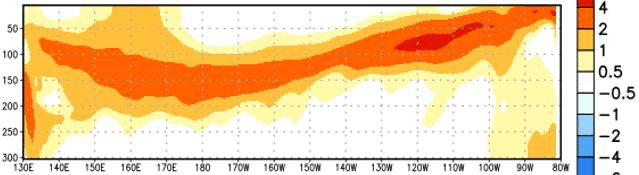 Fig. 1. Temperature anomaly (°C) in equatorial Pacific versus depth (m) and longitude, showing a Kelvin wave that is moving from the western to eastern Pacific (left to right). ¹
Super El Nino? Super Warming is the Main Issue.
Fig. 1. Temperature anomaly (°C) in equatorial Pacific versus depth (m) and longitude, showing a Kelvin wave that is moving from the western to eastern Pacific (left to right). ¹
Super El Nino? Super Warming is the Main Issue.
20 March 2026
James Hansen, Pushker Kharecha, Dylan Morgan and Jasen Vest
Abstract. Models are converging on prediction of an El Nino beginning this year, peaking in early 2027. After overlooking the possibility of an El Nino this year, some reporting is jumping on a “Super El Nino” bandwagon. El Nino strength and frequency are important, especially the issue of whether these are modified by global warming. However, the more important knowledge that needs to be extracted from near-term global warming concerns interpretation of ongoing, extraordinary, acceleration of ocean surface warming. Impacts of this ocean warming include a factor of two greater warming over land, increased extreme precipitation, and poleward movement of subtropical conditions.
The fundamental advance in the past five years in understanding of global climate change is realization that equilibrium climate sensitivity is substantially larger than the longstanding best estimate of 3°C for doubled CO₂ . The underestimate was due to an implicit assumption that aerosol climate forcing changed negligibly during the period of rapid linear warming that began about 1970 and on heavy dependence of climate sensitivity assessments on observed warming of the past century. Multiple data sources now indicate that climate sensitivity is 4-5°C, which is consistent with aerosol-cloud modeling that reveals increasing aerosol cooling during the 1970-2005 period of rapid linear warming because of increased global spread of the aerosol sources. This explains why underlying climate sensitivity must be larger to account for the observed temperature rise. High climate sensitivity and reduction of East Asia and ship aerosol sources in the past 10-15 years combine to drive accelerated sea surface temperature warming. The first author appeals to his longtime friend Bill McKibben to help communicate the current knowledge because of the implications for the wellbeing of today’s young people and their children.
We are developing a website that will be continually updated with the aim of aiding understanding of long-term climate change. We also are now on Substack²
An El Nino is anticipated to begin later this year and peak in 2027. The ECMWF (European Center for Medium-Range Weather Forecasts) model, one of the best models, predicts a strong “Super” El Nino. It is useful to know how strong the El Nino will be because of important effects that El Ninos have on global weather patterns. Let us first clarify how El Ninos work.
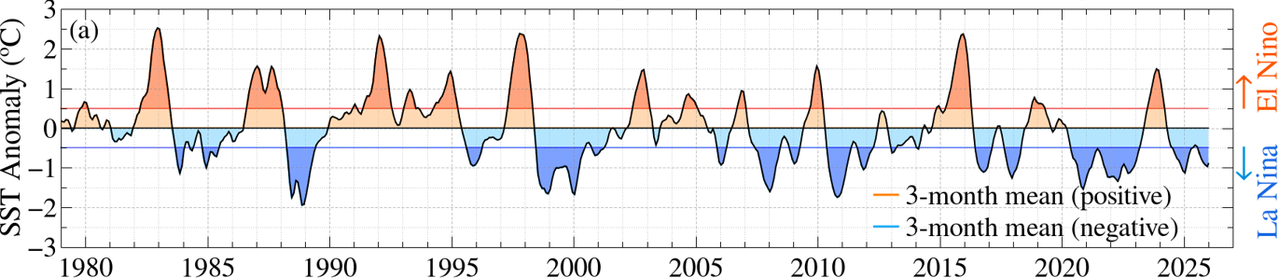
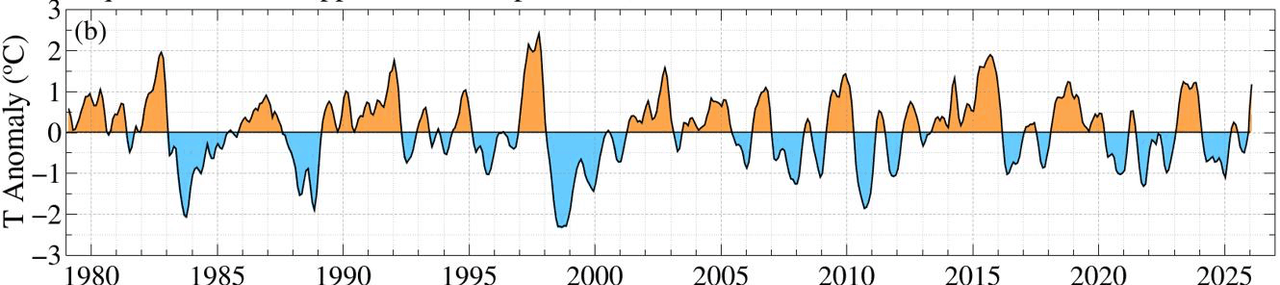 Fig. 2. (a) Nino3.4 SST, 3 (b) equatorial upper ocean (300 m) heat anomaly (°C) 180-100W: both are 3-month running-means except February 2026, which is a 1-month value in (b).
…
