Environment & Energy
Related: About this forum
As E15 Gas Becomes More Common, Remember That It's Terrible For These Engines
I doubt that it's "illegal" to use E15 in old engines, but they weren't designed to run on it.
As E15 Gas Becomes More Common, Remember That It's Terrible For These Engines
BY B. L. JOHNSON APRIL 12, 2026 5:25 AM EST
Way back in 1978, the Environmental Protection Agency (EPA) issued a waiver to the Clean Air Act, allowing gasoline that was made up of up to 10% ethanol, or E10, to be sold at the fuel pump. E10 is still the gas that is most commonly sold today.
Decades later, in 2010, the EPA would begin allowing E15 gas (15% ethanol) to be used, but only in 2007 model year cars or newer. The final rule would allow E15 to be used in 2001 cars and newer, as well as modern flex-fuel engines. E15 is normally not available in the summer, but the EPA has issued waivers in the past few years to allow its sale year-round. (Here's why ethanol is mixed into gasoline in the first place.)
It is illegal to use E15, sold as 88 octane, in older engines. It is also illegal to use it in lawnmowers, motorcycles, boats, heavy-duty vehicles like delivery trucks, and aircraft. Why? Ethanol is not kind to engines, especially older ones, and that 15% amounts to a lot of corn juice blended into your gasoline. If an engine isn't built to deal with ethanol, it can do a lot of damage. But regardless of how old your car is, you should check to see if your manufacturer has even authorized E15 gas to be used in it. Most manufacturers have only authorized its use in cars much newer than 2001, and some don't allow it at all.
{snip}
 = new reply since forum marked as read
Highlight:
NoneDon't highlight anything
5 newestHighlight 5 most recent replies
= new reply since forum marked as read
Highlight:
NoneDon't highlight anything
5 newestHighlight 5 most recent replies

bucolic_frolic
(55,346 posts)bucolic_frolic
(55,346 posts)Who Enforces the Rules?
EPA & FTC: The EPA, in coordination with the Federal Trade Commission (FTC), mandates that every E15 pump must have a specific black and orange warning label.
Retailers: To sell E15, gas station owners must submit a Misfueling Mitigation Plan (MMP) to the EPA, which includes quarterly surveys to verify that pumps are correctly labeled to prevent older cars from using it.
State Weights and Measures: Local state agencies inspect gas pumps for accuracy and proper labeling during their routine maintenance checks.
How to Get Non-E15 Gas
E15 is an optional fuel for retailers, not a replacement for E10. You can still easily avoid it by following these steps:
Look for the Warning Label: Any pump dispensing E15 must have a 3x5 inch label stating "ATTENTION: Use only in 2001 and newer passenger vehicles".
If you see an 88-octane button that is cheaper than the 87-octane "Regular," it is almost certainly E15.
Avoid "Unleaded 88": Many stations market E15 as "Unleaded 88" or "Regular 88".
Stick to E10 or E0: Standard Regular (87), Mid-grade (89), and Premium (91-93) at most stations remain E10, which is authorized for your pre-2000 car. For maximum safety, you can use Pure Gas (E0), which contains zero ethanol.
Check the Nozzle: Some stations use a "blender pump" where one nozzle serves multiple fuel types. Always wait for the screen to confirm your selection before squeezing the handle to ensure you aren't getting residual E15 left in the hose.

hlthe2b
(114,104 posts)Prius are NOT flex fuel vehicles, nor are most others. Read your manual if unsure, but better yet... avoid it.
The lying POS EPA Director Lee Zeldin is claiming the following** (which my Toyota Dealership likewise said it is a blatant lie, so check your manual no matter what make of vehicle you have. American made are less likely to be advised not to use E15 gas, but check!) Don't believe this lying POS nor anyone else in the Trump administration.
**According to the Renewable Fuels Association, E15 is fully approved for use in vehicles manufactured after the year 2000. That equates to more than 96% of vehicles on the road right now. **(uh, huh
 )
)
Old Crank
(7,132 posts)I found that in 2024 about 25% of cars on the road were over 20 years old. So the percentage will be lower than that but I doubt as low as 4%.
hlthe2b
(114,104 posts)are E15 approved is beyond bullshit. Most Japanese manufacturers (not only Toyota) that have approved its use, did not approve its use until well after 2024 and then not all models. My Toyota dealership indicated there are other imported cars that cannot either. Yes, Jeep and other American vehicles can, but...
Well, read your manual and don't listen to what is being reported by the administration is all I can say. And, given the sourcing, I'd have a jaundiced eye toward MSM reporting as well.

ms liberty
(11,270 posts)The highly qualified engineers who designed the car are the authorities on the subject IMO.
Old Crank
(7,132 posts)In the last year or so they seem to be AI slop.
I would research their claims a bit. They could be true.
Now here is a question. Why would I be charged criminally when I use the wrong fuel? I might be charged economically for using the fuel for repairs that might not have been needed.

ffr
(23,426 posts)Let's dissect. First, consider the source. Jalopnik is a nostalgic American automotive news and culture website that tends to focuse on internal combustion cars, car culture, and the automotive industry.
Next. Is ethanol harmful to engines. No. There is no property in ethanol that makes it harmful for "engines." Quite the contrary. Spark ignition 4-stroke engines will actually run cooler and last longer running E10 ethanol based gasoline, especially those that have electronic controlled (ECU) programmed fuel injection. However, higher levels of ethanol in the 15% - 85% require "fuel systems" made for such exotic ethanol flex-fuel ratios. Thus, if your vehicle's owner's manual says it was designed and warranted to use gasoline with up to 10% ethanol, that's what you should use. If your vehicle is flex-fuel, it can run on 85% denatured ethanol blends and anything in between. And again, higher levels of ethanol will promote your vehicles longevity over running conventional ethanol-free gasoline.
In 1977 the FCAA established “substantially similar gasoline,” oxygenates must be approved prior to use in gasoline by the U.S. EPA. This was to standardize gasoline across the U.S. The term "oxygenates" does not refer exclusively to ethanol, because there are many oxygenates that could be blended with gasoline, namely the one most of us know about call MTBE (methyl tertiary butyl ether).
This A.I. (?) generated article seems to imply that E10 gasoline has been sold since the 1978 10% ethanol WAIVER. But for those who thought that, that wasn't the case. There was no supply chain for ethanol back then. The waiver was a continuation of the 1977 standardization of gasoline, setting the structure for what was allowed for retail sale moving forward. For instance, in 1981 11% MTBE guidelines were set as the limit for such gasoline blends. That ratio is no coincidence either. 11% MTBE results in a fuel oxygen level or 2.0%, which would become a future guideline in the 1990 FCAA.
In 1988 15% MTBE was permitted, resulting in 2.7% fuel oxygen, also set in the 1990 FCAA in regards to Consolidated Metropolitan Statistical Areas (CMSA), which were generally valleys or basins with higher levels of CO (Carbon Monoxide) levels.
A.I. may have had difficulty finding such information for the JALOPNIK article.
Back in the 1970s and 1980s, other than boutique outlets in Iowa and elsewhere, that blended ethanol into gasoline, E10 gasohol that included UP-TO 10% ethanol as we know it, wasn't in supply chains until the early 2000s. Prior to that, oxygenated E10 gasoline used ethers; MTBE, ETBE, and TAME. Ether oxygenates are all non-natural toxic substances...but you rarely hear any articles pointing that out!!
So let's move on. E10 with ethanol, was the original boogieman that the petroleum industry went after, using fear tactics identical to this A.I. (?) written article by JALOPNIK? I say A.I. written article, because it follows the exact same pattern as those written 10, 20, 30 years ago, and even recently for the UK. FYI, in the UK, while E10 was allowed for retail sale there since 2013, it wasn't distributed to retailers until September 2021. 2021! That's nearly two decades after California refineries actually used ethanol in their CaRFG3 gasoline. So, misinformation articles in the UK were prevalent there too, until everyone just accepted that E10 was not bad for their "engines," but actually good for their internal combustion engines. Oops!
That's right, E10 ethanol runs cooler AND cleaner in your gasoline powered engine than the old non-oxygenated conventional gasoline. You may have heard of that stuff, it's called ethanol-free gasoline aka E0. Whereas E0 promotes water corrosion, ethanol cleans gasoline hydrocarbon deposits and dries fuel systems of corrosive water. That's due to ethanol's chemical hydrophilic properties, meaning it can absorb the small amount of corrosive water in vehicle fuel systems and transport that water through the combustion process, safely through the engine, while also protecting fuel system metals from water. The part about ethanol extracting water moisture, humidity, from the air is ridiculous. Ethanol is poorly hygroscopic, unable to interact well with humid air, but greatly hydrophilic, readily able to absorb liquid water.
The nonsense about small engines follows this same fear tactic that's mostly untrue, as well. Ethanol based E10 gasoline does the same for small 4-stroke engines as well, removing metal oxidizing water. But get this, because E10 has oxygen in it, carbureted engines at higher altitudes benefit from its use in another way, more power, not just cleaner emissions and drier fuel systems. That's because ethanol brings an oxygen atom to the combustion party. So, at higher altitudes where air density and oxygen levels are lower, these small carbureted engines don't lose as much top-end power as those running the much more expensive ethanol-free E0 gasoline. The e10 running engines produce more power and run cleaner, outperforming and outlasting ones where their owners intentionally handicapped them with ethanol-free E0.
So, what is this story going on about E15 being harmful to engines and voiding warranties? Free yourself from the fearmongers, check your vehicle owner's manual. It will state what levels of fuel oxygenates are allowed. And yes, most carbureted engines will have E10 stamped on their fuel caps. The reason has less to do with E15 being harmful to the engine, it has to do with the fact that carbureted engines cannot regulate fuel ratios, they are passive fuel metering devices. Thus if you add oxygen to the fuel tank, by going from E10 to E15, the result will be higher oxygen levels coming out of the exhaust, from leaner mixtures. The cure then would be to rejet the carburetor with a fuel jet one size bigger.
Bottom line. If you fear E15 gasoline or those that may contain more than 10% ethanol, then free yourself of the petroleum industry. Buy electric.
FYI, California does not require the use of ethanol in gasoline. It regulates the use of fuel oxygenates.
hlthe2b
(114,104 posts)have at it. I will follow what my dealership and my manual indicate. And yes, they point out just how corrosive E15 can be IF the engine is air-cooled and/or to valves, gaskets, rubber lines and rubber parts in general in those vehicles not designed for it. But, do I advise others here to listen to you and your interpretation, rather than their own dealership, owner's manual, car manufacturer and specifically Toyota and the warning given re: my warranty? Umm, no.
YES. Ethanol CAN be corrosive. Basic chemistry 101. YES, the concentration does matter, but to flat out say it cannot is demonstrably FALSE!. If your car and all its parts were not manufactured/designed for the concentration of Ethanol (i.e., 15% rather than 10%) well FAFO.
Please folks. DO your OWN homework on this!
ffr
(23,426 posts)

hlthe2b
(114,104 posts)If you were intending that to have been a section quoting someone else, you did not indicate (no section within quotation marks). Thus, I assumed it to be your opinion. You should probably fix it, if that was not your intention.
If we are in agreement, all the better. Enough propaganda being disseminated out there. DUers need to work against that.
ffr
(23,426 posts)In fact, there's a whole industry out there promoting the use of ethanol and methanol with engines that ran on gasoline. If you've never ventured outside the United States, the Brazilian automotive industry has been using ethanol blended gasolines of greater than 20% ethanol for decades.
I'm sorry you are unaware of these facts. Everything I posted can be cross-referenced, which is why I posted authoritative links in my post to help those unfamiliar with the subjects contained, to learn more. I wish to inform and educate, not pass along folklore, hearsay or what some salesman at a Toyota dealership says.
But if you dig into how it's possible for people to convert their gasoline powered vehicles to ethanol or methanol, there is nothing needed on the "engine" side. What is "beneficial" on the engine side has to do with higher compression pistons or moving towards boosted engine configurations, ones with altered ignition systems to take advantage of these two superior fuels. However, as I pointed out, there are things necessary to do on the "fuel system" side, which is what I clearly point out in the second paragraph of what I posted above.
@hlthe2b: I will follow what my dealership and my manual indicate. And yes, they point out just how corrosive E15 can be IF the engine is air-cooled and/or to valves, gaskets, rubber lines and rubber parts in general in those vehicles not designed for it. But, do I advise others here to listen to you and your interpretation, rather than their own dealership, owner's manual, car manufacturer and specifically Toyota and the warning given re: my warranty? Umm, no.
For those who don't know, E10 gasoline with ethanol does not damage air-cooled and/or to valves, gaskets, rubber lines and rubber parts in general in those vehicles warranted to use E10 gasoline. What you are mostly referring to in regards to gaskets, rubber lines and rubber parts, is primarily a function of gasoline hydrocarbon peroxides that form from hydrocarbon gasoline oxidation, as gasoline interacts with air, heat, and time.
What components of conventional hydrocarbon gasoline cause peroxides? The unstable hydrocarbons known as alkenes or better known as hydrocarbon olefins and di-olefins. These peroxides break down into organic acids and aldehydes that chemically attack the polymer chains in rubber.
Don't believe me?
hlthe2b
(114,104 posts)sans modifications, the automotive industry. You be you. Not sure why you claimed we agreed then but if you do not understand that sans protective modifications ethanol is corrosive to rubber and metal and the higher concentration the more it IS corrosive then I cannot help you. You should have learned EVEN in basic high school chemistry.
ffr
(23,426 posts)I think where you are getting this discussion wrong and taking what I back up in my replies, has to do with how you are commingling terms. Ethanol will not damage an:
engine.
You are not impeaching that fact!
What you are referring to has to do with a vehicle's:
fuel system. I've already covered this in my OP.
See the difference? Engine does not equal fuel system. Ethanol will not chemically damage an engine, because there is no mechanism in the ethanol molecule to do so.
Everything I've stated is fact, especially when it comes to Chemistry 101. Impeach what I've said. If you cannot do that, then at the very least, learn from what I've posted. If you cannot do that, you can take your arguments up with Chevron and others I've used to back up my claims.
hlthe2b
(114,104 posts)But, in response to the poster, I m going to give YOU a start to understand chemistry 101.
Corrosion: Ethanol can be corrosive to metals and degrade certain plastics and rubbers in fuel systems;
Water Absorption: Tends to attract and absorb water, leading to phase separation in fuel and potential engine problems;
Volatility: Ethanol-blended fuels can become less stable over time, especially when stored.
Compatibility: Not all engines are compatible with high-ethanol fuels, potentially leading to damage.
Understanding the Corrosive Nature of Ethanol Fuel
https://www.biodieselfoundation.org/is-ethanol-corrosive/
Ethanol blended fuel was initially embraced for its potential to reduce emissions and serve as an alternative to traditional gasoline. Now, it’s found in over 90% of gasoline sold. However, this widespread adoption has led to unexpected issues. This blog post will explore five significant challenges arising from the use of ethanol in fuel.
Ethanol: Characteristics, Challenges, and Solutions;
Is Ethanol Corrosive?;
The Engine Risks of Ethanol Blended Gasoline;
Ethanol’s Hygroscopic Nature: Mitigating Water-Related Issues;
Ethanol-Induced Corrosion: Protecting Your Assets;
The Impact of Ethanol on Fuel Degradation and Oxidation;
Energy Efficiency in Ethanol Blended Fuels;
Ethanol’s Role as a Microbial Growth Nutrient;
Biobor EB: A Solution to Ethanol-Related Issues;
Long-Term Impacts of Ethanol Fuel Usage;
Ethanol-Related Damage to Fuel Systems and Equipment;
Conclusion.
Ethanol: Characteristics, Challenges, and Solutions
Property Description
Source Primarily derived from plant sources, such as corn and sugarcane.
Oxygenate Functions as an oxygenate, enhancing combustion and contributing to reduced emissions.
Energy Content Contains approximately one-third less energy than gasoline, impacting overall fuel efficiency.
Solvent Properties Exhibits solvent properties, capable of dissolving certain materials, which can affect fuel system components.
Ethanol, also known as ethyl alcohol or grain alcohol, is a sustainable fuel derived from farm-grown resources like corn and sugarcane, among other biomass. Its use in the international fuel landscape, especially as a supplement to gasoline, has surged due to its eco-friendly profile. Ethanol’s contribution to fuel mixtures is multifaceted: it acts as an octane booster, warding off engine pinging, and as an oxygenating agent, enhancing the burn efficiency of fuel, thereby curtailing toxic emissions. The blend that’s most commonly available worldwide is E10, which incorporates a 10% ethanol to 90% traditional gasoline ratio.
However, the application of ethanol in fuels varies widely, with some countries experimenting with higher concentrations like E15 (15% ethanol) or even E85 (85% ethanol) for vehicles specifically designed to operate on high-ethanol content fuels. The use of ethanol is part of a broader strategy to reduce dependency on fossil fuels and lower the carbon footprint of transportation. Ethanol’s renewable nature, derived from plant materials, positions it as a more sustainable and environmentally friendly alternative to traditional gasoline. It is also a significant component in the strategies of various governments and organizations aiming to achieve environmental targets and sustainable energy goals. Despite its benefits, the use of ethanol in fuel systems has led to discussions around its impact on engine performance, fuel efficiency, and compatibility with existing vehicle technologies, highlighting the ongoing evolution and adaptation in the field of renewable energy sources.
This unique fuel possesses distinctive characteristics. Notably, it is hygroscopic, absorbing moisture from the atmosphere, which can lead to storage challenges and accelerated corrosion in fuel tanks. The oxidation of ethanol produces corrosive byproducts, gradually damaging engine components. Additionally, due to its lower energy content compared to gasoline, engines require additional additives for equivalent performance.
Grasping the nature of ethanol is vital for forestalling engine complications. Keeping ethanol-enhanced fuel in an airtight vessel helps avert moisture buildup and maintains the integrity of the fuel. Adding Biobor EB, a fuel preservative, to your ethanol-infused fuel can protect against issues that arise with prolonged storage. For superior defense against the erosive tendencies of ethanol, turning to Biobor EB is indispensable. Tailored to combat moisture retention and the resultant rust in critical engine components like valves, pistons, and gaskets, Biobor EB delivers all-around security. Making educated choices about ethanol-mixed fuels and conducting consistent preventative upkeep, such as integrating Biobor EB, are critical measures in preventing engine troubles linked to ethanol-based fuels.
Challenges of Ethanol Use:
Corrosion: Ethanol can be corrosive to metals and degrade certain plastics and rubbers in fuel systems;
Water Absorption: Tends to attract and absorb water, leading to phase separation in fuel and potential engine problems;
Volatility: Ethanol-blended fuels can become less stable over time, especially when stored.
Compatibility: Not all engines are compatible with high-ethanol fuels, potentially leading to damage.
ffr
(23,426 posts)That's your reference? A blog? Where are your authoritative references? 
I'm going to impeach what you use as your reference, which I assume is where you're getting your facts from.
Case in point: This unique fuel possesses distinctive characteristics. Notably, it is hygroscopic, absorbing moisture from the atmosphere, which can lead to storage challenges and accelerated corrosion in fuel tanks.
Stating that ethanol is hygroscopic by definition impeaches your earlier claim about not violating basic Chemistry 101. Ethanol is defined in chemistry as a covalent hydrophilic (1) polar molecule. You should understand these terms.
Hydrophilic means water loving, dissolves in "liquid" water.
Polar means the molecule is electrically charged, with distinct positive and negative charged regions
Covalent means that it shares electrons between atoms
But also, ethanol's ability to absorb water is temperature dependent
What defines a hyrgroscopic element for this discussion? They are substances that tend to absorb water vapor from the air. So, what are commonly used substances for drawing water vapor from the air? Desiccants - Calcium chloride, calcium sulfate, activated carbon, zeolites and silica gel are all common desiccants.
Hygroscopic Zeolite molecule
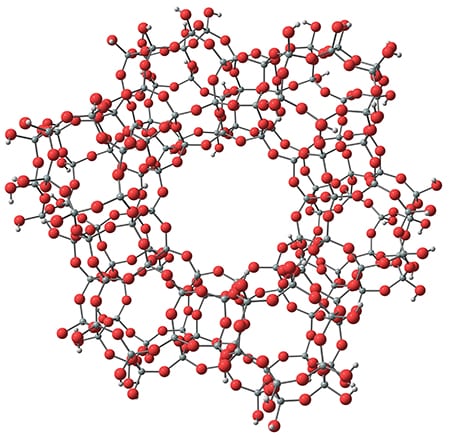
Hygroscopic Desiccant silica gels

What defines these Ionic substances? They are:
Metals or near metals on the periodic table
Highly polar molecules
Is ethanol a metal or near metal? No.
Is ethanol highly polar? No.
Is ethanol an ionic molecule? No.
Is ethanol temperature dependent in how much water it can absorb? Yes.
Hydrophilic Ethanol molecule
 ?w=768
Can ethanol still have hygroscopic properties? Yes. But just as hydrophobic octane hydrocarbons can absorb traces of water vapor from the air, it simply means given enough time and it will take a lot of time, if you're using ethanol to absorb water vapor from the air, you're going about that solution all wrong. Ethanol it is poorly hygroscopic. You should use an ionic compound to absorb water vapor.
Impeaching your other highlighted point at the bottom about gasoline phase separation. I guess you failed to read the whole study. - Thus, this was what was found in a Water Phase Separation in Oxygenated Gasoline study. Pgs 1 and 4 - 5
Introduction - While separate water phases in a fuel can be damaging to an engine, small amounts of water in solution with gasoline should have no adverse effects on engine components...
Another way water can enter gasoline is through absorption from the air. Water, in the form of water vapor, can dissolve in gasoline. The more humid the air, the faster the water vapor will dissolve in the gasoline. Due to chemical equilibrium, however, assuming a constant temperature, phase separation will never occur if the only source of water is from the air. Only enough water to saturate the fuel can enter the system, and no more. Water vapor, however, dissolves in gasoline very slowly, even at very high humidity. For example, at a constant temperature of 100 degrees F and relative humidity of 100%, it would take well over 200 days to saturate one gallon of gasoline in an open gasoline can (assuming the only source of water is water vapor from the air). Water absorption from the air is far slower at lower temperatures and humidities. (At a temperature of 70 degrees and relative humidity of 70%, it would take over two years to saturate one gallon of conventional gasoline in the same gasoline can.) Again, oxygenated gasolines can hold more water than conventional gasoline, and would therefore take much longer to saturate with water.
To further impeach what you refer to ethanol's engine damaging phase separation, ignores the fact about conventional gasoline, the other gasoline that does not contain ethanol. By definition phase separation is when something separates into two or more separate phases. Ethanol-free E0 gasoline contains no ethanol. Right? There's no hydrophilic ethanol in conventional E0 gasoline. Hydrocarbon gasoline is hydrophobic, water hating. What do you think happens with the corrosive water condensation that occurs in fuel tanks with only ethanol free conventional gasoline? If you guessed that after sloshing with the water droplets the gasoline settled at the top and the water settled at the bottom, you'd be correct. Water, as in the old water-doesn't-mix-with-oil analogy, settles to the bottom IN A STRATIFIED PHASE SEPARATED LAYER. So, by your definition of why ethanol can damage an engine, because it can phase separate with water, then how damaging is running straight water through your engine that's at the bottom of a fuel tank with conventional gasoline going to be when it's picked up from the fuel tank's sump pickup?

1 - Water and alcohols have similar properties because water molecules contain hydroxyl groups that can form hydrogen bonds with other water molecules and with alcohol molecules, and likewise alcohol molecules can form hydrogen bonds with other alcohol molecules as well as with water. Because alcohols form hydrogen bonds with water, they tend to be relatively soluble in water. The hydroxyl group is referred to as a hydrophilic (“water-loving”) group, because it forms hydrogen bonds with water and enhances the solubility of an alcohol in water. Methanol, ethanol, n-propyl alcohol, isopropyl alcohol, and t-butyl alcohol are all miscible with water. Alcohols with higher molecular weights tend to be less water-soluble, because the hydrocarbon part of the molecule, which is hydrophobic (“water-hating”), is larger with increased molecular weight.
hlthe2b
(114,104 posts)more than a quote from W.C. Fields today, it seems but so damned apropos for you.
Again, anyone who repeatedly denies that Ethanol is corrosive is beyond uneducated in basic chemistry. And no, I have no need to provide you a reference list when you obviously have never gotten past basic chemistry. Thus, you would not understand, but yet pick up on terms you think will make you sound "educated," no matter how unrelated to the issue at hand. No, it does not make you sound informed, just able to cut and paste without addressing the issue at hand.
Telling DUers to ignore their own manufacturer's own evidence for what is safe to use in their specific model and year of car is so beyond indefensible that I will simply advise others to talk to those who they KNOW to be informed and not content to dispense potentially seriously damaging advice.
We know you don't care, but I do.
Duers. Beware and be wary. If your car can run on E15, you are about to have that as an option. But, if it cannot or is not advised to, do NOT listen to those like the poster above who clearly don't care what the consequences might be for your following THEIR misinformed advice.
So, now do go and dazzle with bullshit, but kindly don't cause others harm by doing so.
ffr
(23,426 posts)You're taking this personally. Please don't. I'm not attacking you, I'm attacking what you wrote, impeaching it with authoritative information you can read for yourself. I'm trying to help you and others understand this subject better.
To be a liberal is to take in all of the information that is available, weed through the facts from the chaff, to form a logical conclusion. I'm a liberal. And welcome to DU.
@hlthe2b ...anyone who repeatedly denies that Ethanol is not corrosive is beyond uneducated in basic chemistry.
@hlthe2b Telling DUers to ignore their own manufacturer's own evidence for what is safe to use in their specific model and year of car is so beyond indefensible
Those two statements from you are both Straw man fallacies. I never said either. If you read any of my posts or searched them, I never stated that Ethanol was not corrosive. In fact, I consistently eluded to that very fact by my repeated use of the differences between how it is safe to use with an "engine," however higher levels of ethanol in the 15% - 85% require "fuel systems" made for such exotic ethanol flex-fuel ratios. Thus, if your vehicle's owner's manual says it was designed and warranted to use gasoline with up to 10% ethanol, that's what you should use.
I've been consistent, because I've studied this material for years. I have, wow more than I care to confess to having, more than my fair share of authoritative references on this subject, peer reviewed studies, lab studies, and governmental linked documents, all at my fingertips. One set of evidence builds upon the next which builds upon the next, etc., etc., etc... And much of it relies on the knowledge that comes from chemistry, not unverified or A.I. generated blogs. Which again, when it comes to ethanol being safe for engines, there's a whole industry out there supporting vehicle owners converting from gasoline to E85 ethanol or methanol applications. It's not only safe for their engines, I use what I've learned in my ICE vehicles.  And I use it against my peers who don't understand this topic.

My E10 running vehicles outrun and outperform their similar vehicles. And it pisses them off to no end.  So if you still think I'm wrong on any of what I've written, man, after thumping them on their heads for going on 18 years and 200,000 miles, it feels so good to be wrong! -- Now that is hearsay! Don't believe any of it.


People are doing these conversions and finding that E85 ethanol use in particular and E10 use to a lesser degree cleans hydrocarbon engine deposits, dries fuel systems and extends the life of their vehicles. Less hydrocarbon engine deposits mean more power overall and this should be right up all of our alleys, fewer engine hot-spots that could trigger engine damaging combustion mixture pre-ignition.