Environment & Energy
Related: About this forum
James Hansen et al -- Super-Duper El Nino
https://www.columbia.edu/~jeh1/mailings/2026/Super-Duper%20El%20Nino.2026.04.15.pdfJames Hansen, Pushker Kharecha, Dylan Morgan and Jasen Vest
Abstract. El Ninos have always been important. However, in the context of a warming planet – likely accelerated warming – El Ninos have even greater impact. Moreover, the frequency and nature of El Ninos themselves may be affected by the warming. Media attention to the possibility of an upcoming “Super El Nino” irritates some scientists, given inherent uncertainty in forecasts. We push back gently against that irritation. Predictions in the face of uncertainty are a valuable approach, with the potential to increase our understanding. We take our hats off to ECMWF for their bold prediction. We also suggest an El Nino diagnostic, alternative to the usual diagnostic, that provides an earlier, more meaningful assessment. It is already clear that we will have an El Nino in 2026-27. A little more time is needed to be certain that it will be a Super El Nino, but it looks like it will be a strong one. Let us see what we can learn from it.
The figures in this post and our other current papers will be continually updated on our website,¹ when they remain relevant. We are also now on Substack².
The European Center for Medium Range Weather Forecasts (ECMWF) earlier this year issued a forecast of a strong (“Super”) El Nino to begin later this year and peak in early 2027, as we have discussed in two earlier posts.³ ⁴ El Ninos are important because of the large effects that they have on global weather, even though those effects are not always consistent from one El Nino to another. El Ninos have even greater effect in combination with ongoing global warming, e.g., Radfar et al.⁵ find that the combination of an El Nino with increasingly prevalent marine heat waves results in tropical cyclones consistently producing higher maximum wind speeds, storm surges, and precipitation rates, and Liu et al.⁶ describe evidence of El Ninos strengthened control over global climate anomalies in a warmer world.
Reid⁷ says that the phrase “Super El Nino” makes Australian climate scientists roll their eyes, and advises ignoring El Nino forecasts made during Australian autumn (Northern Hemisphere spring) – suggesting to wait until the end of autumn or early winter (end of spring or early summer in the Northern Hemisphere) before taking forecasts seriously. Reid concludes: “Will we get an El Nino this year? The only scientifically accurate answer as of April 9, 2026, is ‘maybe.’ It’s way too early to say anything other than that an El Nino is more likely to form this year than a La Nina.”
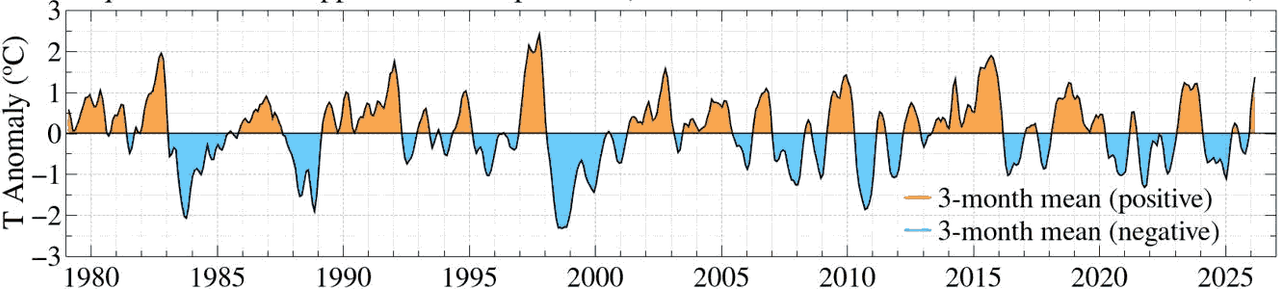
Fig. 1. Equatorial upper ocean (300 m) heat anomaly (°C) at longitudes 180-100W. This is the 3-month running-mean except March 2026, which is a 1-month value.
Our perspective is different. First, predictions have the potential to increase understanding. If one believes that he/she has the basis for a prediction, we encourage such prediction and a postmortem that attempts to get at the physics of what went right or wrong in the forecast – and why. ECMWF is recognized as having a good model and top-notch scientists, so we look forward to their analysis of the forecast/reality comparison. There are inherent limitations on predictability caused by chaotic aspects of atmosphere and ocean dynamics, but that cannot account for the huge range among models. It is common to look at the range of model results and treat this as if it were a probability distribution for the real world. It is not. It is simply the fog of results from all models – the good, the bad, and the ugly – and a rather fruitless comparison. What is needed is analysis of the effect of key processes in the better models. Well observed and analyzed events, such as the upcoming El Nino, provide an opportunity to test simulation of key processes.
…
 = new reply since forum marked as read
Highlight:
NoneDon't highlight anything
5 newestHighlight 5 most recent replies
= new reply since forum marked as read
Highlight:
NoneDon't highlight anything
5 newestHighlight 5 most recent replies

NNadir
(38,192 posts)I would think that spending 5.689 trillion dollars on so called "renewable energy" between 2015 and 2025 would have caused nirvana break out.
It didn't?
Who knew?
By the way, Jim Hansen isn't the only scientist in the world who gets it. Of course I do admire him myself since he and I are aligned on the most important idea involved in energy technology to address this crisis, nuclear energy, which between 2015 and 2025 was supported by only 0.6 trillion dollars, about 10% of what the so called "renewable energy" scam soaked up for no result other than the rising rate of collapse of the planetary atmosphere.
I'll bet if we could ask Dr. Hansen for his thoughts on this he just might be appalled. But if Im wrong and he isn't, I sure am.
Have a nice evening.