Welcome to DU!
The truly grassroots left-of-center political community where regular people, not algorithms, drive the discussions and set the standards.
Join the community:
Create a free account
Support DU (and get rid of ads!):
Become a Star Member
Latest Breaking News
Editorials & Other Articles
General Discussion
The DU Lounge
All Forums
Issue Forums
Culture Forums
Alliance Forums
Region Forums
Support Forums
Help & Search
Foreign Affairs
Related: About this forum
Trump's Tariffs Are Illegal. What's Next for Russia, Europe, and Everyone Else? - William Spaniel
Earlier today, the Supreme Court declared the vast majority of the Trump Administration's tariffs unconstitutional. These were the taxes that Trump had used to threaten U.S. trade partners, impose secondary sanctions, and keep opponents out of the Caribbean. This video examines what will happen next, which policies Congress might work to reimplement, and the other creative methods Trump might use to reimpose tariffs.
0:00 Liberation Day Tariffs, Then and Now
0:59 The Supreme Court Case
3:20 The Supreme Court's Ruling
5:11 The Supreme Court as a Political Actor
6:53 The Market's Response
8:11 Secondary Sanctions and the War in Ukraine
9:29 The Quarantine of Cuba
10:30 Trade with Allies and Partners
11:08 Trump's Next Move
12:45 The Brave New World of Tariffs
1 replies
 = new reply since forum marked as read
Highlight:
NoneDon't highlight anything
5 newestHighlight 5 most recent replies
= new reply since forum marked as read
Highlight:
NoneDon't highlight anything
5 newestHighlight 5 most recent replies
= new reply since forum marked as read
Highlight:
NoneDon't highlight anything
5 newestHighlight 5 most recent replies
Trump's Tariffs Are Illegal. What's Next for Russia, Europe, and Everyone Else? - William Spaniel (Original Post)
TexasTowelie
Saturday
OP

LetMyPeopleVote
(177,725 posts)1. Trump's plan B to impose new tariffs is also illegal because a balance-of-payments deficit doesn't exist, trade experts
Section 122 tariffs can only be used when there is a balance of payments deficit which does NOT exist. Someone did not read the statute before letting trump try this executive order
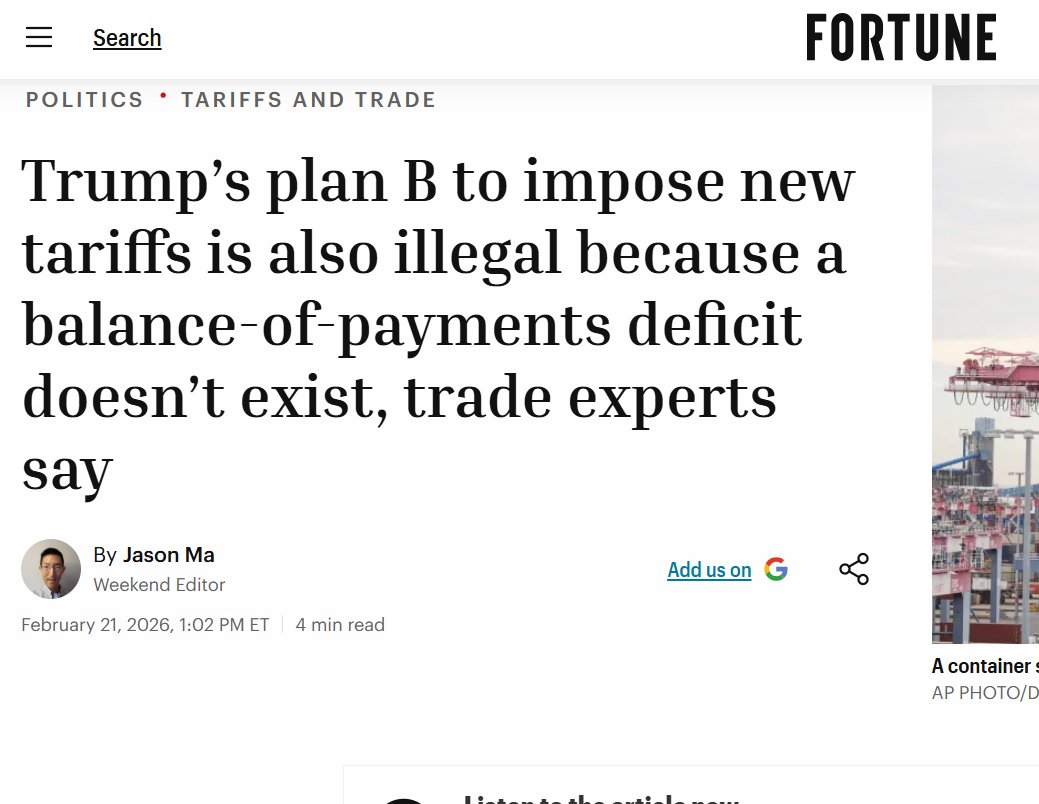
Trump’s plan B to impose new tariffs is also illegal because a balance-of-payments deficit doesn’t exist, trade experts say fortune.com/2026/02/21/t...
— Ian Kremer (@leadcoalition.bsky.social) 2026-02-22T19:12:07.516Z
#tariffs #economics #economy #law #SCOTUS
https://fortune.com/2026/02/21/trump-tariffs-section-122-trade-law-trade-deficit-capital-account-surplus-balance-of-payments/
Just hours after the Supreme Court struck down President Donald Trump’s global tariffs on Friday, he signed an order to impose another package of levies under a different law that wasn’t affected by the court’s decision......
But the actual language of the Trade Act lists requirements that don’t exist today, including a “large and serious” balance-of-payments deficit.
While the U.S. has run a trade deficit for decades, it’s been offset by capital inflows as foreign investors pour billions into financial markets, resulting in a net balance of zero.
“Section 122 of the 1974 Trade Act, on which Trump’s 10% tariff is based, does not apply in the current macro environment,” said Peter Berezin, chief global strategist at BCA Research, in post on X on Friday. “A balance of payments deficit is not the same thing as a trade deficit. You cannot have a balance of payments [deficit] if you have a flexible exchange rate, as the US currently does.”
Similarly, economist Alan Reynolds, a senior fellow at the Cato Institute, pointed out that the trade deficit is fully funded by the capital account surplus, adding that there is no overall balance-of-payments deficit to justify Trump’s newest tax on imports.....
“Section 122 only authorizes tariffs in the presence of a fundamental international payments problem,” he added. “Because the United States does not face such a problem, Section 122 cannot legally be used by President Trump to impose new tariffs.”
But the actual language of the Trade Act lists requirements that don’t exist today, including a “large and serious” balance-of-payments deficit.
While the U.S. has run a trade deficit for decades, it’s been offset by capital inflows as foreign investors pour billions into financial markets, resulting in a net balance of zero.
“Section 122 of the 1974 Trade Act, on which Trump’s 10% tariff is based, does not apply in the current macro environment,” said Peter Berezin, chief global strategist at BCA Research, in post on X on Friday. “A balance of payments deficit is not the same thing as a trade deficit. You cannot have a balance of payments [deficit] if you have a flexible exchange rate, as the US currently does.”
Similarly, economist Alan Reynolds, a senior fellow at the Cato Institute, pointed out that the trade deficit is fully funded by the capital account surplus, adding that there is no overall balance-of-payments deficit to justify Trump’s newest tax on imports.....
“Section 122 only authorizes tariffs in the presence of a fundamental international payments problem,” he added. “Because the United States does not face such a problem, Section 122 cannot legally be used by President Trump to impose new tariffs.”