Cooking & Baking
Related: About this forum4 More Home Recipes From "German Meals At Oma's" (Granny's) 🌞

Tafelspitz mit Meerettich-Sosse
(Boiled Beef with Horseradish Sauce)
For fork-tender beef and an amazing beef broth, make this
German classic that originated in Austria. The method is so
simple and always works to get the beef super tender. It’s
important to remember that the meat needs to be
completely plunged into boiling water to seal its pores. If
the water is not boiling or the pot too small to submerge the
meat, it will end up as tough as shoe leather. Choose your
pot wisely as explained in the recipe and make sure your
water is boiling, and you’ll be rewarded with a
mouthwatering roast every time. When it’s served with the
fresh horseradish sauce, this beef is a winner!
Serves 4
Beef
1¼ lb (570 g) beef chuck or bottom round roast
6 cups (1.5 L) water, or as needed
1 tbsp (15 g) butter
1 large onion, unpeeled
2 large carrots, coarsely chopped
1 large leek, coarsely chopped
1 cup (227 g) cubed celeriac or 1 cup (100 g) coarsely chopped
celery
1 tsp salt, plus more as needed
1 dried bay leaf
4 black peppercorns
2 cloves
HORSERADISH SAUCE
3 tbsp (45 g) butter
3 tbsp (24 g) all-purpose flour
½ cup (125 ml) broth from cooking the beef½ cup (125 ml) milk
3 tbsp (45 g) freshly grated horseradish
Salt and freshly ground black pepper, as needed
To make the beef, choose a saucepan that is big enough to allow the
roast to be fully submerged in water. Check the size by putting the
roast in the saucepan and covering it with approximately 6 cups
(1.5 L) of cold water, submerging the roast by at least 1 inch (2.5
cm). Then, remove the meat and measure how much water was
used. Dry the saucepan. Prepare the roast by removing any excess
fat and silver skin with a sharp knife.
Melt the butter in the saucepan over medium-high heat. Cut the
onion in half and put the halves, flat-side down, in the saucepan and
sauté for 2 to 3 minutes, or until the onion has lightly browned. Add
the amount of water that was measured earlier when you
submerged the roast and increase the heat to high. Bring the water
to a boil. Add the roast and return to a boil. Add the carrots, leek,
celeriac, salt, bay leaf, peppercorns and cloves. Let the water come
to a boil again, reduce the heat to medium-low and skim off the
foam that comes to the top. Cover the saucepan and simmer gently
for 2 hours, or until the meat is tender. Ladle about 1 cup (250 ml)
of broth through a sieve to use for making the sauce.
To make the horseradish sauce, melt the butter in a small skillet
over medium heat. Whisk in the flour until no lumps remain and the
roux is smooth, which will take about 1 minute, but do not let it
brown. Whisk in the broth and milk until the sauce is creamy.
Reduce the heat to medium-low and simmer for about 5 minutes.
You may need to add more broth if the sauce becomes too thick. Stir
in the horseradish, adding more if you like it hotter, and season
with salt and pepper.
To serve, remove the meat from the broth, slice it and place the
sauce on the side. Boiled potatoes are the traditional
accompaniment for this.
Note: The extra broth can be used for making soup, especially
Gaisburger Marsch (Beef and Veggie Stew).
**************************************************************
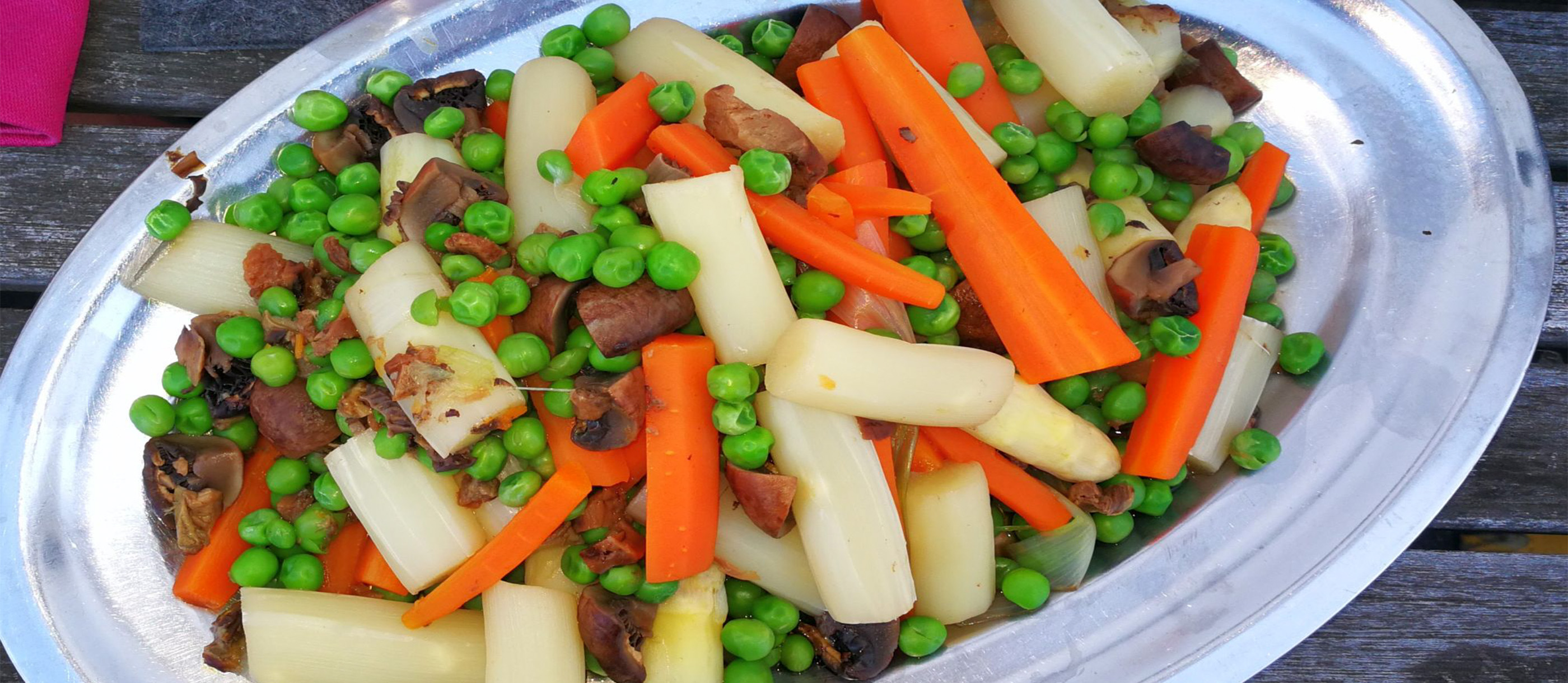
Leipziger Allerlei
(Veggie Stew)
The most famous of Leipzig’s dishes is this mixture of
vegetables. The story behind it is varied, making the
original ingredients a bit of a mystery as well. For some, it’s
a medley of just vegetables, cooked in a special way. For
others, it also includes various seafood, including crawfish.
For me, it’s just veggies, and I cook it the easy way. Just as
delicious and just as traditional. Traditional means “the way
you’ve always done it” and allerlei means “a variety of,” so
this is a variety of veggies, just the way you like it.
If possible, use the freshest vegetables you can find. With
the asparagus and sugar snap peas, that means this really is
a spring dish. Add your own favorite veggies if you like,
such as kohlrabi and green beans. Omit the ones you don’t
like and create your very own traditional Leipziger Allerlei!
Serves 4 to 6
2 cups (500 ml) beef broth
4 tbsp (60 g) butter, divided
1 tsp salt, plus more as needed Pinch of sugar
2 cups (250 g) thinly sliced carrots
2 cups (300 g) fresh cauliflower florets
½ lb (227 g) green asparagus, cut into bite-sized pieces
1½ cups (120 g) sugar snap peas
2 cups (170 g) button or cremini mushrooms, thickly sliced
2 tbsp (16 g) all-purpose flour
½ cup (125 ml) heavy cream
Freshly ground white pepper, as needed
Freshly grated nutmeg, as needed
2 tbsp (5 g) finely chopped fresh parsley, for garnish
Combine the broth, 1 tablespoon (15 g) of the butter, salt and sugar
in a large saucepan over high heat. Bring the broth to a boil and add
the carrots. Cover the saucepan, reduce the heat to medium-high
and simmer for 5 minutes. Add the cauliflower. Cover the saucepan
and simmer for 5 minutes. Stir in the asparagus and the peas. Cover
the saucepan and simmer for 5 minutes. Drain the vegetables,
reserving the cooking liquid in a medium bowl. Put the vegetables
in another medium bowl and cover the bowl to keep the vegetables
warm. Measure the cooking liquid and add enough water to make
1½ cups (375 ml) to use for the sauce.
Melt 1 tablespoon (15 g) of the butter in the saucepan over medium
heat and add the mushrooms. Cook for about 5 minutes to soften
them. Transfer the mushrooms to the vegetables in the bowl. Melt
the remaining 2 tablespoons (30 g) of the butter in the saucepan
over medium heat and whisk in the flour. Continue stirring until the
roux is smooth, which will take about 1 minute, but do not let it
brown. Whisk in the reserved cooking liquid and simmer for about 5
minutes. Stir in the cream. Season the sauce with additional salt,
pepper and nutmeg.
Gently stir the vegetables into the sauce and heat, but do not let the
mixture simmer. Serve garnished with the parsley.
Oma’s Ecke
The traditional method calls for cooking each vegetable
separately in water with salt and butter. The veggies are
then shocked in ice water and set aside. Once all are
cooked, they are combined with the sauce and perhaps
some crawfish and crawfish butter.
I prefer to cook the veggies together, adding them at
different times so that they are tender at the same time. It’s
a bit easier to do it this way and makes the whole process
just a bit faster.
*************************************************************************

Tiegelbbraten
(Beef And Lamb Pot)
Literal translations sometimes do not work, because
tiegelbraten would then be a pot roast—and that is totally
what this is not. Tiegel is a special type of pot that this
mixed meat dish was served in, especially for wedding
breakfasts. Braten is a roast that has been roasted, yet a
tiegelbraten is not roasted but rather braised.
The original dish, using whole roasts, strains the onions out
and does not include them in the final dish. However, by
searing the meat cubes and the onions together, a lovely
complexity of flavors develops. This is usually served
without thickening the gravy. Personally, I like to thicken
it, making it just a touch richer. Another popular addition
that is delicious is to sprinkle cheese over the top and let
that get bubbly and brown in the oven. Served with crusty
white bread, the wedding breakfast is complete. Served with
potatoes, dinner is ready.
Serves 6
3 tbsp (45 g) clarified butter or 3 tbsp (45 ml) neutral oil
¾ lb (340 g) boneless lamb, cut into ¾-inch (2-cm) cubes (see
Oma’s Ecke)
2 lb (908 g) boneless beef sirloin steak, cut into ¾-inch (2-cm)
cubes
2 cups (300 g) diced onions
4 cups (1 L) hot beef broth
2 dried bay leaves
½ tsp salt, plus more as needed
4 tbsp (60 g) butter
4 tbsp (32 g) all-purpose flour
Freshly ground black pepper, as needed
¾ lb (340 g) Emmental or Gouda cheese, grated
This recipe can be prepared in an oven-safe 11-inch (28-cm) skillet
to prepare the entire dish, or a 9 x 13–inch (23 x 33–cm) baking
dish can be used for the final baking stage.
Melt the clarified butter in the skillet over medium-high heat. Add
the lamb and beef and brown the meat on all sides, 8 to 10 minutes,
working in batches and being careful not to crowd the meat.
Transfer the browned meat to a large bowl. Add the onions to the
skillet, reduce the heat to medium and sauté for 5 to 7 minutes, or
until the onions are translucent. Add the broth, stirring up any
browned bits from the bottom. Return the meat and any
accumulated juices to the skillet. Add the bay leaves and salt.
Increase the heat to medium-high and bring the mixture to a boil.
Reduce the heat to medium-low, cover the skillet and simmer for 45
minutes, or until the meat is tender.
Preheat the oven to 450°F (232°C).
Using a slotted spoon, transfer the meat and most of the onions to
another large bowl and strain the cooking liquid to use for the
gravy. Remove the bay leaves.
Melt the butter in the skillet over medium heat and whisk in the
flour. Continue stirring until the roux is smooth, which will take
about 1 minute, but do not let it brown. Whisk in about 3 cups (750
ml) of the strained cooking liquid and simmer until the gravy is
thickened, about 2 minutes, adding a bit more liquid if the gravy is
too thick. Stir in the meat with the onions and season with salt and
pepper.
Keep the meat, onions and gravy in the skillet if it is oven-safe. If
not, transfer it to the baking dish. Sprinkle the cheese evenly over
the top. Bake for 15 minutes, until the top is bubbly and the cheese
has browned.
The Tiegelbraten is ready to serve with crusty white bread for
dunking or with potatoes that have been garnished with chopped
parsley.
Oma’s Ecke
Traditionally, this is made with a half-and-half mixture of
beef and lamb. I prefer making it with just beef, a delicious
twist on the original. You could even substitute some
boneless pork chops for the lamb.
***********************************************************************

Huhnerfrikassee
(Chicken Fricasee)
Making this will have you thinking you are right back in
oma‘s kitchen. She would take leftover chicken and mix it
with whatever was found in the fridge to create a delicious
fricassee. This “leftover dish” now graces the menus in even
the best German restaurants.
Just like me, you’ll be cooking extra chicken in order to
have leftovers to make this (or you can even use a
purchased rotisserie chicken).
If you want to start from scratch, put about 1 pound (454 g)
of raw chicken breasts in a medium saucepan and cover
them with boiling chicken broth or water. Add ½ teaspoon
of salt and simmer gently over low heat, covered, for at least
15 minutes, skimming off any foam that forms on the top.
The internal temperature should be 165°F (74°C). Use the
meat and its broth for the fricassee.
Serves 4
4 tbsp (60 g) butter, divided
8 oz (227 g) button or cremini mushrooms, thickly sliced
4 tbsp (32 g) all-purpose flour
4 cups (1 L) hot chicken broth
1 cup (150 g) frozen green peas, thawed
1 (15-oz [420-g]) can white asparagus, drained, cut into 1½-
inch (4-cm) slices
4 cups (500 g) cooked cubed chicken meat
Salt and freshly ground black pepper, as needed
1 large egg yolk mixed with 4 tbsp (60 ml) heavy cream
2 tbsp (5 g) finely chopped fresh parsley or chives, for garnish
In a large saucepan over medium-high heat, melt 2 tablespoons (30
g) of the butter and add the mushrooms. Sauté them for 4 to 5
minutes, until they are lightly browned. Remove the mushrooms
and set them aside.
Make a roux by melting the remaining 2 tablespoons (30 g) of the
butter in the saucepan, lowering the heat to medium and whisking
in the flour. Continue stirring until the roux is smooth, which will
take about 1 minute, but do not let it brown. Whisk in the broth and
stir until smooth. Return the mushrooms to the sauce, cover the
saucepan and simmer for about 5 minutes.
Add the peas, asparagus and chicken. Simmer for 3 to 4 minutes,
until the peas are cooked. Season with the salt and pepper. Take the
saucepan off the heat and immediately stir in the egg yolk mixture.
Serve the Hühnerfrikassee garnished with the parsley and a side of
rice.
Oma’s Ecke
One of the fun things I love to do in the kitchen is to make
small changes to traditional recipes. Sometimes it doesn’t
work out. Often it does.
For this recipe, here are a few interesting additions to try:
Add 1 teaspoon of capers to the finished sauce. Or add a bit
of zip by including 1 tablespoon (15 ml) of fresh lemon
juice. Add extra spices if you wish—paprika, cayenne
pepper or nutmeg. Use a mix of green peas and carrots or
frozen cauliflower florets instead of just peas. Omit the
asparagus, or use green asparagus instead. Each of these
will make your traditional dish something totally different.
All the above from "German Meals At Oma's"
Heartwarming as always! Enjoy!


 = new reply since forum marked as read
Highlight:
NoneDon't highlight anything
5 newestHighlight 5 most recent replies
= new reply since forum marked as read
Highlight:
NoneDon't highlight anything
5 newestHighlight 5 most recent replies

Redleg
(6,781 posts)My mother's family is German and we lived over there for 7 years and got to enjoy my Oma's and aunt's "country style" German food when we visited the family farm. All the food was wonderful and most came from their farm and what didn't come from their farm came from my mother's cousins bakery.
A typical Sunday meal would start with soup, which often had marrow balls in it. This was accompanied by a nice vegetable salad, often with a remoulade sauce or a vinegrette. Then came the main course, schnitzel or cutlets, perhaps a beef roast, potato balls and gravy. I do miss living over there.

justaprogressive
(6,053 posts)German food! 

Redleg
(6,781 posts)It is quite comforting to me. Alas, we have so few German restaurants in the area, and I haven't added German cooking to my repertoire. That reminds me- my sister recently gave me a German cookbook and I might try some things during the upcoming semester break.
justaprogressive
(6,053 posts)Get your feet wet with some simple stuff, and gain the confidence to do
the more complex stuff...