Astrophysics turned upside down by unique 'inside out' planetary system
Discovery of four planets creates radical new perspective on how celestial bodies are formed
12 February 2026
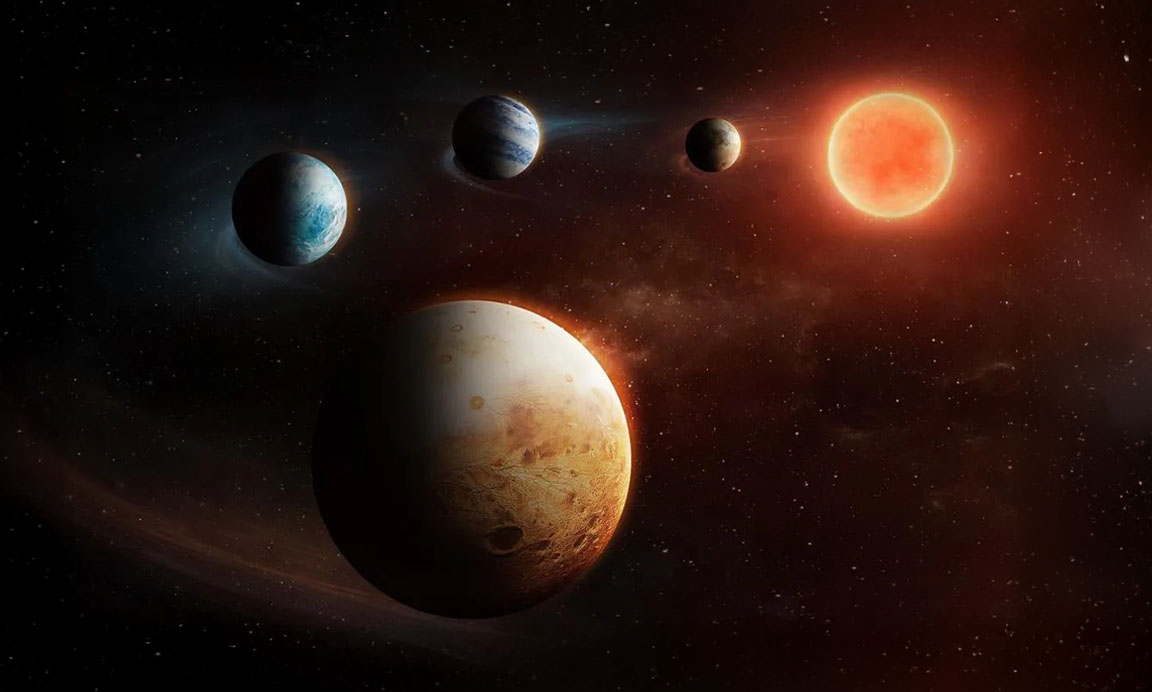
Artist impression of the planetary system around the star LHS 1903 (Credit: ESA. Licence: CC BY-SA 3.0 IGO or ESA Standard Licence)
University of Birmingham astronomers joined a global team of scientists to discover a distant planetary system that turns scientific understanding of planet formation upside down.
In the Solar System, the inner planets (Mercury to Mars) are rocky, and the outer planets (Jupiter to Neptune) are gaseous. This pattern – rock to gas – has been consistently observed across the Milky Way until now.
Using a European Space Agency (ESA) telescope, the international research team took a closer look at a star called LHS 1903. Publishing their observations in Science, the researchers reveal a system of four planets that breaks this convention. This is the furthest observable planetary system still in the Milky Way – some 116 lightyears away from Earth.
Confirming the uniqueness of this remarkable system using my specialised analysis pipeline was incredibly exciting. It truly felt like standing at the forefront of scientific discovery. I’m grateful to be part of an international team of outstanding astronomers working together on a discovery that challenges convention.
Dr. Ancy Anna John - University of Birmingham
The planets around LHS 1903, a cool faint red dwarf star, begin as expected with a rocky planet orbiting close by and then two gas worlds. ESA’s CHaracterising ExOPlanet Satellite (CHEOPS) then reveals a surprising fourth planet at the system’s outer edge which is rocky, rather than gaseous.
More:
https://www.birmingham.ac.uk/news/2026/astrophysics-turned-upside-down-by-unique-inside-out-planetary-system
