Welcome to DU!
The truly grassroots left-of-center political community where regular people, not algorithms, drive the discussions and set the standards.
Join the community:
Create a free account
Support DU (and get rid of ads!):
Become a Star Member
Latest Breaking News
Editorials & Other Articles
General Discussion
The DU Lounge
All Forums
Issue Forums
Culture Forums
Alliance Forums
Region Forums
Support Forums
Help & Search
Anthropology
Related: About this forum
Book Review: How Sickness Has Transformed Civilization
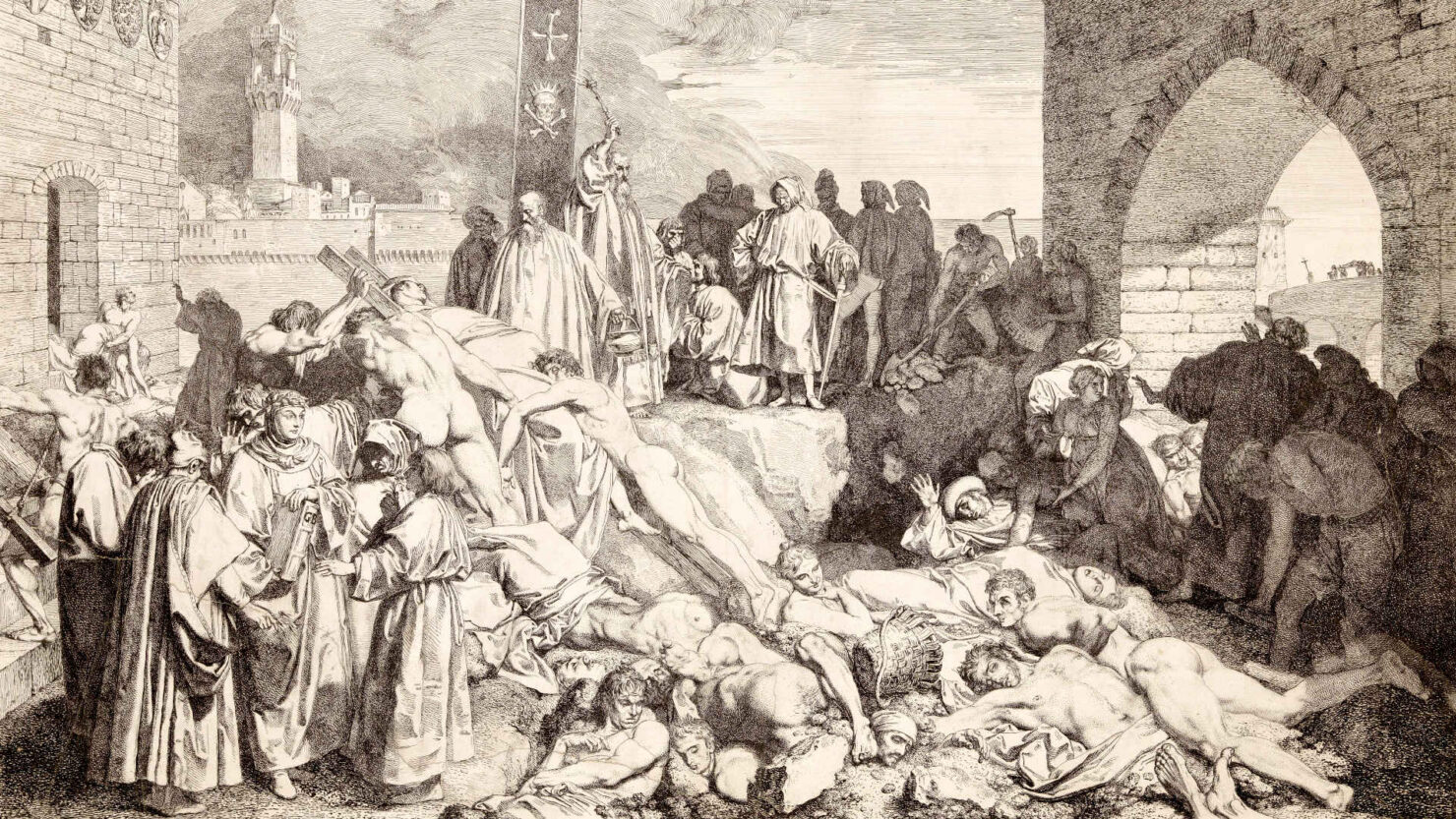
“The Great Shadow,” by Susan Wise Bauer, is a sweeping survey of humanity’s relationship to illness over the centuries.
Top: Giovanni Boccaccio’s “The plague of Florence in 1348.” Visual: Wellcome Collection
By Emily Cataneo
02.16.2026
On a cold spring day in 542 AD, a galley ship dropped anchor at the Golden Horn in Constantinople, bearing a load of grain from Egypt. Workers swarmed the ship, unloading much-needed supplies that would feed the hungry city. But the delivery came with a cost. Soon, the Byzantines started falling ill. With fevers. With swelling in their armpits and groins, or black lentil-sized pustules. They raved, they fell into comas, they perished. The city’s towers became makeshift grave pits. Along with sickness, fear stalked the city: “Walking home through the streets, you might hear a disembodied voice whisper death into your ear and know that you were doomed.”
Sickness is an experience that’s touched every human being and community since the beginning of time. In her latest book, “The Great Shadow: A History of How Sickness Shapes What We Do, Think, Believe, and Buy,’’ historian and author Susan Wise Bauer tackles an ambitious project: in some 300 pages, she weaves the story of humanity’s relationship to illness over the past four millennia, from ancient Sumerians calling on priests to prescribe incantations against cold-causing demons to those Byzantines facing the horrors of the plague to Victorians terrified of “sewer gas” drifting out of their toilets.
By weaving an intellectual, medical, and social history of our relationship with illness, Bauer aims to show just how much of modern society has been shaped by our forbears’ fears and beliefs. Her central argument is that “it is the constant presence of sickness, not injury, that has shaped the way we think about ourselves and our world.” In the wake of the Covid-19 pandemic and in the midst of increasing distrust of medical science, writes Bauer, it’s more important than ever that we understand how we got here, and what that means for our future.
Unlike most nonfiction authors, who open with an introduction or preface outlining their thesis and main points, Bauer throws us almost immediately into the Neolithic Revolution, when humans settled down to farm. She explains that when humanity started living in close proximity to one another and to livestock, diseases such as malaria, diphtheria, and smallpox started their slow and evil evolution. Her narrative continues at breakneck speed, covering ancients’ exhortations to gods, early physicians’ attempts at using actual treatments to combat illness, and the turning point catalyzed by Hippocrates, whose theory of disease as caused by imbalance of humors took root in ancient Greece and lasted for nearly 20 centuries. Under this schema: “People didn’t ‘get sick.’ They slipped slowly into imbalance as their lives went askew. Righting that imbalance could lead to a cure.”
More:
https://undark.org/2026/02/16/book-review-great-shadow/
3 replies
 = new reply since forum marked as read
Highlight:
NoneDon't highlight anything
5 newestHighlight 5 most recent replies
= new reply since forum marked as read
Highlight:
NoneDon't highlight anything
5 newestHighlight 5 most recent replies
= new reply since forum marked as read
Highlight:
NoneDon't highlight anything
5 newestHighlight 5 most recent replies
Book Review: How Sickness Has Transformed Civilization (Original Post)
Judi Lynn
Feb 2026
OP

Biophilic
(6,770 posts)1. Sounded interesting. Got a sample.
Very interesting and well written. Now I’m deeply into the book. Honestly one of the best reads I’ve had this year.

PoindexterOglethorpe
(28,493 posts)2. That looks amazing.
My library doesn't have it, so I think I'll request they order it.

Easterncedar
(6,641 posts)3. See also Plagues and Peoples by William McNeill
I read it more than 40 years ago, and it profoundly informed my understanding of the relationships between micro and macroparasitism in the evolution of human civilization. A very engaging history.